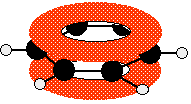
A Modern view of the structure of benzene.
An orbital model for the benzene structure
Building the orbital model
Benzene is built from hydrogen atoms (1s1) and carbon atoms (1s22s22px12py1).
Each carbon atom has to join to three other atoms (one hydrogen and two carbons) and doesn't have enough unpaired electrons to form the required number of bonds, so it needs to promote one of the 2s2 pair into the empty 2pz orbital. This is exactly the same as happens whenever carbon forms bonds - whatever else it ends up joined to.
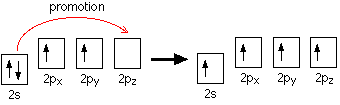
An orbital model for the benzene structure Building the orbital model
Because each carbon is only joining to three other atoms, when the carbon atoms hybridise their outer orbitals before forming bonds, they only need to hybridise three of the orbitals rather than all four. They use the 2s electron and two of the 2p electrons, but leave the other 2p electron unchanged.
The new orbitals formed are called sp2 hybrids, because they are made by an s orbital and two p orbitals reorganising themselves. The three sp2 hybrid orbitals arrange themselves as far apart as possible - which is at 120° to each other in a plane. The remaining p orbital is at right angles to them.

Each carbon atom now looks like the diagram on the right. This is all exactly the same as happens in ethene.
The difference in benzene is that each carbon atom is joined to two other similar carbon atoms instead of just one. Each carbon atom uses the sp2 hybrids to form sigma bonds with two other carbons and one hydrogen atom. The next diagram shows the sigma bonds formed, but for the moment leaves the p orbitals alone.
Only a part of the ring is shown because the diagram gets extremely cluttered if you try to draw any more.
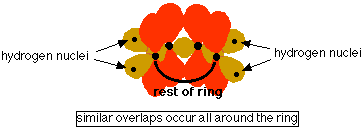
Notice that the p electron on each carbon atom is overlapping with those on both sides of it. This extensive sideways overlap produces a system of pi bonds which are spread out over the whole carbon ring. Because the electrons are no longer held between just two carbon atoms, but are spread over the whole ring, the electrons are said to be delocalised. The six delocalised electrons go into three molecular orbitals - two in each.
In common
with the great majority of descriptions of the bonding in benzene, we
are only going to show one of these delocalised molecular orbitals for
simplicity. In the diagram, the sigma bonds have been shown as simple lines to
make the diagram less confusing. The two rings above and below the
plane of the molecule represent one molecular orbital. The two
delocalised electrons can be found anywhere within those rings. The
other four delocalised electrons live in two similar (but not
identical) molecular orbitals.
The shape of benzene This is easily explained. Benzene is a regular hexagon because all
the bonds are identical. The delocalisation of the electrons means that
there aren't alternating double and single bonds. The energetic stability of benzene This is accounted for by the delocalisation. As a general principle,
the more you can spread electrons around - in other words, the more
they are delocalised - the more stable the molecule becomes. The extra
stability of benzene is often referred to as "delocalisation energy". The reluctance of benzene to undergo addition reactions With the delocalised electrons in place, benzene is about 150 kJ mol-1
more stable than it would otherwise be. If you added other atoms to a
benzene ring you would have to use some of the delocalised electrons to
join the new atoms to the ring. That would disrupt the delocalisation
and the system would become less stable. Since about 150 kJ per mole of benzene would have to be supplied to
break up the delocalisation, this isn't going to be an easy thing to do. The symbol for benzene Although you will still come across the Kekulé
structure for benzene, for most purposes we use the structure on the
right. The hexagon shows the ring of six carbon atoms, each of which has
one hydrogen attached. (You have to know that - counting bonds to find
out how many hydrogens to add doesn't work in this particular case.) The circle represents the delocalised electrons. It is essential
that you include the circle. If you miss it out, you are drawing
cyclohexane and not benzene.